
 My name is Chen Su Lin and this is a typical day in 1943 Syonan (formerly British Singapore) part of the Greater Japanese Empire.
We rise early, while it is still dark, because our island is now run on Japan time. We’re encouraged to do outdoor morning exercises in the garden following radio instructions broadcast on ‘Rajio Taisou’. This involves a lot of arm circles, squats, jumping, toe touching, bending over, and so on. Childhood polio left me with a limp that makes this difficult, but I go in front of the house to be seen and counted with everyone else.
Sometimes Japanese officials drive past and we all bow. They think we are cheering them with ‘Banzai!’ which is a long life blessing in Japanese. But often what is shouted is ‘Bangsai!’ or passing shit. . . Singaporeans do what we have to, to survive. That doesn’t mean we’ve lost our spirit.
Breakfast is steamed tapioca balls rolled dipped in gula melaka (palm sugar) and grated coconut. Before the War, tapioca was grown mostly to feed pigs and chickens. Now we eat it at almost every meal—and that’s because we are lucky enough to have grounds to grow food and close enough to the sea to harvest salt, fish and shellfish.
According to Uncle Chen’s wife whose sister Mimi works at the Japanese officers club at Emerald Hill, Japanese officers dine on omelettes and sharks’ fins and ten course banquets are served to Japanese VIPs. The Japanese took over British supplies after the Surrender and seem to enjoy Worcestershire sauce, Coleman’s mustard and canned ox tongue mixed into rice. They are also drinking their bottles of Hennessy and Johnnie Walker while British POWs working in chains beg for water.
Even on a typical day like this, I know I don’t want to accept this as our new normal.
We spend most of the day trying to find food while staying out of trouble. There is no rice or wheat flour, but we grow jagong or corn, and grind the dried kernels in a granite mortar to make a crude bread. And we get sago starch from the pith of the sago palms that grow around the mangrove swamps.
In the evening, we go out with kerosene lamps to catch eels hiding behind the concrete slab stuck into the monsoon drain. Eels are delicious fried with sambal chilli paste or grilled in banana leaves.
Every day we survive is a triumph but I worry about my friends constantly. Some, like Chief Inspector Le Froy and Dr Shankar are in prison. Others, like my best friend Parshanti, escaped upcountry when the Japanese first came.
Some people still believe the British will return as they promised. Others say the Australians haven’t given up on us, we just have to hold on till they figure out a way to break through. All I wanted to do until then was keep my head down and stay unnoticed.
That worked fine until our neighbour, Mr Mirza, a known Japanese informer, was found dead in his garden clutching a branch from the mimosa tree. And my Uncle Chen was one of those fingered for his murder.
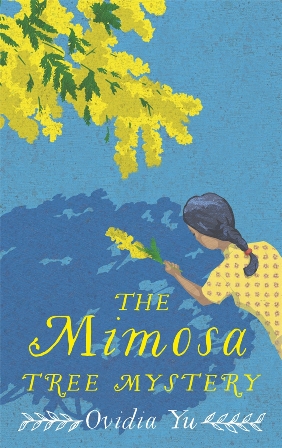
The Mimosa Tree Mystery is the fourth book in the “Crown Colony” historical mystery series, paperback released September 8, 2020.
Mirza, a secretive neighbour of the Chens in Japanese Occupied Singapore, is a known collaborator and blackmailer. So when he is murdered in his garden, clutching a branch of mimosa, the suspects include local acquaintances, Japanese officials — and his own daughters.
Su Lin’s Uncle Chen is among those rounded up by the Japanese as reprisal. Hideki Tagawa, a former spy expelled by police officer Le Froy and a power in the new regime, offers Su Lin her uncle’s life in exchange for using her fluency in languages and knowledge of locals to find the real killer.
Su Lin soon discovers Hideki has an ulterior motive. Friends, enemies and even the victim are not what they seem. There is more at stake here than one man’s life. Su Lin must find out who killed Mirza and why, before Le Froy and other former colleagues detained or working with the resistance suffer the consequences of Mirza’s last secret.
Purchase Link
# # # # # # # # # # #
About the author
Ovidia Yu lives in and writes about Singapore and her books show the often-comic consequences of practical, pragmatic, food loving, Singaporeans trying get along with each other while solving ghastly murders. Apart from the murders, historical, geographical and Singlish details in the books are as accurate as she can make them. While The Mimosa Tree Mystery brings back some characters from her history tree series, it’s the first book in the Syonan Trilogy. Visit Ovidia’s website at ovidiayu.com.
All comments are welcomed.
This sounds really good. I love to read and find out things from this area of WWII…
Marilyn ewatvess@yahoo.com
Fascinating. On my TBR list now.
This book sounds fascinating. I will be adding to my TBR list.