
 The seagulls wake me. Every morning, the same argument above Perth Road, as though overnight they’ve forgotten who owns which chimney pot and the whole territorial negotiation has to start from scratch.
I make instant coffee — I keep meaning to buy a proper cafetière — and stand at the bay window in socks and yesterday’s jumper. The flat still looks temporary. Six months and nothing on the walls. My ex once said I love buildings because they can’t leave me, and I’d like to report that he was wrong, but the bare plaster isn’t helping my case.
I’m on Balgay Hill by seven, which the Heritage Trust finds eccentric. Low light rakes a surface. It shows you what a building would rather keep to itself — the hairline crack, the repointed mortar that’s a shade too fresh, the spot where a mason ran out of good stone and hoped nobody would ever look closely.
I always look closely. It’s the only thing I’m reliably good at.
My contract is a year: survey the Victorian fabric of the hill, the paths, the observatory with its little copper dome, the stone bridge that steps across the ravine as if the ravine were an inconvenience. The bridge is the most interesting structure up here. A hundred and forty-odd years of lime mortar holding coping stones in place, and the joints tell you everything if you know how to read them; where the weather’s been worst, where someone’s done repairs, where the stone is quietly giving up.
Buildings will tell you the truth if you’re patient enough to listen.
A man walking a spaniel stops to ask if I should be up here on my own.
I say I’m quite all right, thank you.
He says that isn’t what he meant.
Everyone gets to it eventually; the woman in white who walks this hill, depending on who’s telling it and how much they’ve had to drink. I’ve collected eleven versions since March. I write them all down. Not because I believe them. Because a story that persistent is doing work for somebody, and I’d like to know who.
Lunch is a flat white at Tethered, the coffee shop on Perth Road where Priya knows my order and asks nothing about my personal life, which makes her my favourite person in Scotland. My neighbour Hamish keeps bringing stew to my door uninvited. The woman at the bookshop remembers what I bought but not my name. Dundee keeps offering me things I didn’t ask for, and I keep accepting them without quite admitting what that means.
Afternoons are condition reports, evidence of later intervention typed more times than is strictly reassuring. Then home along the river as the haar rolls in and the old mills stand there full of nothing, holding their shape, keeping whatever it is they keep.
Dundee is very good at keeping things.
I came here to look at buildings. I’m starting to suspect the buildings are looking back.
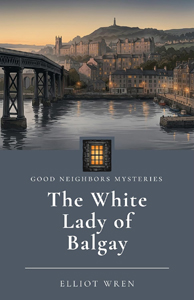
THE WHITE LADY OF BALGAY
Series: A Good Neighbors Mystery, Book 6
Genre: Cozy Mystery
Release: March 2026
Format: Digital
Purchase Link
In Dundee, every bridge carries a story.
Architectural historian Nora Fielding came to Scotland for a one-year contract and no entanglements. Six months later, she is still living out of half-unpacked boxes in a flat on Perth Road, documenting the city’s mills, stonework, and fading industrial landmarks for the Heritage Trust. Buildings make sense to Nora. They hold still. They tell the truth, if you know how to read them. People are harder.
When Fiona Rattray, Nora’s sharp-minded mentor at the Heritage Trust, is found dead below Balgay Bridge, the loss stuns the city. The police treat it carefully. Quietly. But Nora cannot shake the feeling that something about Fiona’s death is wrong. The bridge has its own local legend, the White Lady, said to walk there at night, and in a city layered with old griefs, vanished industries, and stories people still tell in lowered voices, the line between folklore and fact begins to blur.
As Nora starts asking questions, Dundee opens itself to her in unexpected ways: a coffee shop owner who notices everything, a neighbor with a long memory for local history, archivists, reporters, harbor families, and women who seem to have been quietly keeping watch over the city for much longer than anyone admits. What begins as a search for the truth about one death becomes something deeper: a mystery rooted in the hidden life of a real place, and in the burdens a community chooses to carry.
Set against the stone streets, river light, parks, mills, and haunted history of Dundee, The White Lady of Balgay is a mystery of secrets, memory, and belonging, gentle in tone, rich in atmosphere, and threaded with the quietly uncanny. Perfect for readers who love mysteries grounded in real places, with authentic communities, satisfying revelations, and just a hint that the world may be stranger than it first appears.
About the author
Joshua Howard has spent his career in technology and video games, and has been writing for even longer. Most recently he founded Smith & Word, a small imprint exploring new and non-traditional ways of creating fiction—including the Good Neighbors Mysteries, published under his pen name, Elliot Wren. He is drawn to work that blends craft with unconventional process.
I love this opening. So compelling! And the voice is quite different from most cozies. It’s my next read.
Thank you! I hope you enjoy it enough to take a look at the other books in the Good Neighbors Mysteries series!
I am very intrigued! I want to hear more from Nora – and her occupation of architectural historian sounds like great fun to read more about. I am married to a structural engineer and he does a lot of this in his work. It’s fascinating!
Thank you! All of the Good Neighbors Mysteries feature leads with interesting professions, including a London mediator, a Big Island large-animal vet, an architectural salvage specialist in Miami Beach, a health-policy consultant in Oaxaca. Finding ways to connect what they do to the underlying crime is part of the fun in creating these mysteries 🙂