 When my mother died, I started thinking a lot about belonging. I always assumed if you lived in a place long enough, you belonged there. But after she died, I felt I didn’t belong in Oxfordshire anymore. It was too full of memories. I had spent my entire childhood there, and my grief threatened to swallow me – my mother was such a consuming presence in my life.
But now, I’m not sure I ever belonged in Oxfordshire. Shortly after her death, I took a trip to North Yorkshire, and the moment I arrived, I felt I was home. The landscape, the people, the weather – it all felt familiar in a mystical, spooky way, like a return to some ancient roots. As a bookish, somewhat sheltered Cambridge grad with a degree in comparative literature, you would think I was a bit too posh for the practical, plain-spoken folk of Yorkshire.
But I’ve never been the posh type – Cambridge was lovely, but I never felt at home there either. It was a bit too precious, overly intellectual and self-involved; I had the feeling people there looked down on the rest of the world. I suppose any university town has its share of head-in-the-clouds types, and in many ways I was one of them. But I admire people who can do things, create things with their hands, practical people who can change a tyre or make a proper souffle or a decent shepherd’s pie.
After four years with my head stuck in books, I needed a change. And so I packed up and moved to Kirkbymoorside, right on the edge of the North Yorkshire Moors. I love it here – my best friend Farnsworth is the town eccentric (or one of them – there are too many to count.) She makes amazing coffee, and always surprises me with her quick wit and wisdom. She’s older than I am – I like having friends of all different ages. I’m also good friends with Polly Marlowe, who’s ten going on forty. She lost her mother too, and I’ve become a sort of maternal figure for her, which is sort of flattering and a little scary.
I bought a bookstore, where I also live, and I’ve started writing poetry again – good thing too, since I’m related to Samuel Taylor Coleridge. I don’t show it to anyone, but hopefully I’ll work up the courage and try to get some of it published. And I’ve joined the local Jane Austen Society, which is full of delightfully quirky people – as well as some that are not so delightful.
But I love it here. I love the way the hills rise and fall at unexpected angles, dotted with white bundles of grazing sheep. I love the wide sweep of sky over deep, crooked valleys, the way clouds rush over the moors in a great hurry, creating shifting pockets of light and shadow. I love this constantly moving landscape that feels so alive, even in the dead of winter, when the gorse is brown and dry, and the purple bloom of heather is just a memory. And I love these people, who tell you what’s on their mind without mincing words, plain spoken and hardworking, who don’t think much of folks who put on fancy airs.
I love my little cottage by the stream, full of books and music, my old piano and all the things that remind me of my mother. I still miss her, but I when I hear the coo of the mourning dove in the spice bush, and the whoosh of wind sweeping in from the moors, I know I’ve come home.
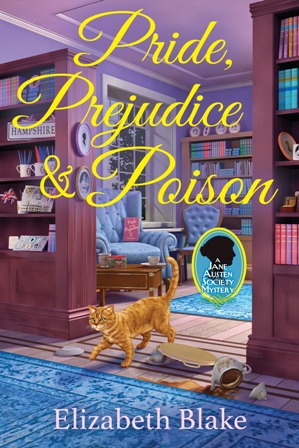
You can read more about Erin in Pride, Prejudice and Poison, the first book in the NEW “Jane Austen Society” historical mystery series, released August 13, 2019.
In this Austen-tatious debut, antiquarian bookstore proprietor Erin Coleridge uses her sense and sensibility to deduce who killed the president of the local Jane Austen Society.
Erin Coleridge’s used bookstore in Kirkbymoorside, North Yorkshire, England is a meeting place for the villagers and, in particular, for the local Jane Austen Society. At the Society’s monthly meeting, matters come to a head between the old guard and its young turks. After the meeting breaks for tea, persuasion gives way to murder―with extreme prejudice―when president Sylvia Pemberthy falls dead to the floor. Poisoned? Presumably. . .but by whom? And was Sylvia the only target?
Handsome―but shy―Detective Inspector Peter Hadley and charismatic Sergeant Rashid Jarral arrive at the scene. The long suspect list includes Sylvia’s lover Kurt Becker and his tightly wound wife Suzanne. Or, perhaps, the killer was Sylvia’s own cuckolded husband, Jerome. Among the many Society members who may have had her in their sights is dashing Jonathan Alder, who was heard having a royal battle of words with the late president the night before.
Then, when Jonathan Alder narrowly avoids becoming the next victim, Farnsworth (the town’s “cat lady”) persuades a seriously time-crunched Erin to help DI Hadley. But the killer is more devious than anyone imagines.
Perfect for fans of Laura Levine and Stephanie Barron.
Purchase Link
# # # # # # # # # # #
Meet the author
Elizabeth Blake (Carole Bugge, C. E. Lawrence, Carole Lawrence) is the author of twelve published novels, award-winning plays, musicals, poetry and short fiction. Her most recent novel is the historical thriller Edinburgh Dusk, sequel to Edinburgh Twilight, and the second of the Ian Hamilton Mysteries. Her “Silent” series (Silent Screams and its sequels) follows NYPD profiler Lee Campbell in his pursuit of serial killers. Her plays and musicals have been performed internationally, including an original Sherlock Holmes musical. Her most recent musical is Murder on Bond Street, based on a true story. A self-described science geek, she likes to hunt wild mushrooms.
To learn more about Carole, visit her website at celawrence.com.
All comments are welcomed.
Don’t you just love it when you find a new series you want to read and one county didn’t bother ordering it and the other only placed an order for ebooks. I’m just going to have to hit Amazon and spend some of my S.S. check on a copy.
Thank you so much, Nora-Adrienne – much appreciated! I hope you like it. ( ;
– Carole (Elizabeth)