
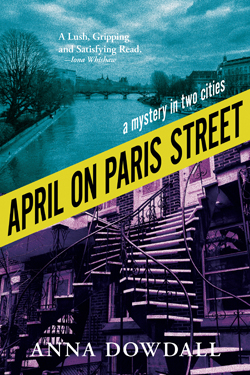
 My name is Hubert, although you may called me Hughey, the neighbourhood kids do. My “owner,” Ashley Smeeton, twenty-something Montreal private investigator, thinks she rescued me in the third book in which she appears–April on Paris Street (2021). The author hints that I’m an eminently adequate substitute for the handsome vaurien Ashley’s involved with, and who am I to disagree? Be that as it may, I spend a certain amount of time–let’s say 30 minutes daily, or 15 percent of my waking time–worrying about my mistress. I don’t know how she’d feel about that if she knew. There are parts of Ashley’s inner life where no one is allowed to go. Plus, she’s very independent. Kind? No one’s kinder. But aloof, if you know what I mean.
It could have all begun with her childhood in small-town Quebec. She’s an odd plump child, solitary, self-sufficient. You have to picture her, her long black braids whipping around her face as she goes about her business, which even then is sticking her nose in other people’s business. Her family is poor. Her Abenaki dad is dead, and her mom, Marlene, struggles. She meets some nice rich Montreal women over the Christmas holidays and of course there’s a murder and that Anna Dowdall can’t seem to write a book without larding it with weather so there’s a stupendous cold snap followed by a winter storm. Some of After the Winter (2017) is told from little Ashley’s point of view, and you get glimpses of her feelings: sore that her only skirt is her school uniform skirt, thrilled to be included as the housekeeper’s kid on a Christmas day sleighride, nosy as heck about the shenanigans around her.
She’s the first person in her family to go to university, in Montreal, where she studies social work. But, in the way of mysteries, she becomes a licensed private investigator. In The Au Pair (2018), she’s got licensing problems and, partly due to a beery bet with her cop friend/mentor, takes on a lucrative summer job au pairing in the mountains north of Montreal. The wealthy family at sinister Columbine Lodge gives new meaning to dysfunctional, and there are the inevitable murders. In this book, Ashley’s come a long way though. She’s tall and awkwardly elegant, and can sometimes look fab. And she’s a martial arts ace. This comes in handy, with one particular slimeball. Once again, though, you see her at her best in her relations with other women. There’s a subtlety and a tenderness there. Kind of like real life, you know? Myself, I prefer women. I’ve found they give more treats. As for Ashley, she goes about her business as best she can, solving the murders in her own way, which tends not to be the way of the justice system.
You really see this role she plays as the keeper of other women’s secrets in April on Paris Street. Maybe that’s a part of why I worry about her. Other people’s secrets can feel heavy after a while. While she’s carrying for other people, who is carrying for Ashley? There’s me of course. But there’s also her circle, in her working class neighbourhood of Pointe Saint-Charles. And her mother, Marlene, who has done well for herself, is a source of strength for Ashley. This is also where Ashley reconnects over Christmas with her dead father’s Abenaki relatives, after a long estrangement between the families. It’s an important time for Ashley, and all any of us can do is watch and hope. In the other two books, you know she’s part Abenaki, but it’s more of a fact on the horizon. Here you realize it’s core to who Ashley is. And yet, we’re all on the outside looking in. To the question, who is Ashley? you now have to add a perspective of, say, a good ten thousand years. But you can sometimes understand, like when you see her wondering about her dead father, his little life snuffed out by time, as her little life will be one day.
But Ashley’s nothing if not stoical and practical, and she needs these traits when she hangs out with rich hare-brained Mirabel Saint Cyr in Paris. Secrets, revenge, domestic strife—Anna Dowdall piles them on, plus there’s a lot about clothes, the author’s second biggest obsession after weather. (Of course, they’re in Paris during the snowstorm of the century.) One critic has described the characters in this book as “quirky, funny and dangerous.” My favourite is a demented Tinkerbell named Mireille Borel. She hails from the French Caribbean and has hoodlum Marseillais brothers. Unlike Ashley, she knows exactly what she wants.
So, as I say, I worry about Ashley. I have every confidence in her, but you know the way it is. Cats can be divided in their minds too. Is this why we all bond with Ashley, in the end? Because she’s an everywoman, cosmically caught between destiny and time? These are deep thoughts. I think I’d better nap on them.
April on Paris Street
Genre: Traditional Mystery
Release: December 2021
Purchase Link
In April on Paris Street, a Montreal private investigator of half-Abenaki heritage takes a case that looks like old-school damsel in-distress rescue but that then turns into something unnervingly different. The narrative weaves working class Ashley Smeeton’s personal story (trying to connect with her Abenaki relatives, the death of a grandmother she’s hardly known, an ill-considered fling with a handsome vaurien) into the story of the privileged young woman, Mirabel Saint Cyr, whose fashion mogul husband hires her.
Against the backdrop of the Parisian winter Carnaval, the job first takes her to the city of lights where she’s drawn into an unsettling world of mirages and masks, not to mention the murderous Bortnik brothers. When Ashley returns to Montreal, a city rife with its own unreasonable facsimiles, the case incomprehensibly picks up again. Convinced she’s being played, she embarks on an even more dangerous journey into deception and uncertainty.
The conclusion of April on Paris Street reveals a long-hidden domestic secret and a recklessly decisive endgame that cause Ashley to question her previous views not only of Mirabel Saint Cyr, but of herself and the world. In a world of masks behind masks, it’s hard to say where the truth lies.
 About the author
Anna Dowdall was born in Montreal and recently moved back there, which surprised no one but her. She’s been a reporter, a college lecturer and a horticultural advisor, as well as other things best forgotten. Her well-received domestic mysteries, After the Winter and The Au Pair, feature evocative settings and uninhibited female revenge, with a seasoning of moral ambiguity and noir. She reads obscure fiction in English and French and thinks Quebec is an underrecognized mise en scène for mystery and domestic suspense.
All comments are welcomed.
thanks Hubert for letting us know about your human mom