
 “So why are we not telling people that your family owned this place?” George asks as we walk through the shade garden to the old servant entrance of Hotel 1911. He’s been the chef here for years and my best friend longer than that.
I only started this job a month ago after he put in a good word for me with the owner, Clarista King. “It’s hard to explain, I guess. But I just don’t feel like a Morrow, most of the time.”
My mother’s family built this Beaux Arts mansion as their private residence in 1911, and Clarista came along in 2008 and turned it into a hotel. Between those years, my family lost their fortune, and I lost my mother, along with any connection I should have to the Morrow family.
I say goodbye to George at the staff changing room where I package myself in a neck-to-toe black ensemble a la Marie Curie. Except for George’s chef’s coat, all of the hotel employee uniforms are modeled after the servants’ clothing in 1911, part of Clarista’s elaborate period theme.
My shift begins at the front desk in the entry hall where I check in a few arriving guests. All the while, a strange sense of unease niggles at me. Something should be here that isn’t.
Wearing his usual three-piece suit, the hotel’s “butler” Mr. Fig strides in from the garden with an armload of Stargazer lilies for the hall table. With his natural sense of propriety, he’s more adept than any of us at keeping up the illusion that our guests have traveled back in time.
To be honest, the man’s perfection intimidates me a bit, but I like him better than any boss I’ve had before.
“Miss Nichols.” Mr. Fig stops at the desk and looks around. “Have you any idea what’s become of today’s newspaper?”
The newspaper. That’s what belongs on the desk. Of course, guests sometimes peruse it, but they usually only take it as far as the sofa and chairs here in the hall.
“No, sir. I just noticed it was missing myself,” I say.
“How unfortunate.” He frowns. “That copy was the only spare. I’m afraid a guest spilled coffee on the first one this morning.”
Odd. Is this a simple coincidence or is someone trying to make sure no one else reads that paper?
Why though? Like always, today’s newspaper is a fresh reprint of The Chattanooga Daily Times from this date in 1911. It probably features a scandal about someone, but not anyone living.
But I’m always keeping an eye on the headlines myself, hoping there’ll be a story about my family from way back when. I know so little about them.
When I get a break, I go on safari for the missing paper. I check the morning room, the conservatory (scented by the blooming orange tree), and the theater with no luck. I do find a woman reading by the fireplace in the cavernous library, but her nose is in one of the old books.
I peek at the desk. All is still, so I take a moment to check outside.
In the afternoon light, the classical statues cast long shadows on the terrace. It’s late June and getting too hot for spending time out here, but a woman in a wheelchair chats with a friend by the tiered fountain, and a couple strolls near the bluff where a breeze drifts up from the river.
Someone yawns beside me, and I glance over.
A mustachioed man with dark sunglasses is lying by the terrace pool.
And reading the newspaper.
Bingo. I zip over and land on the neighboring chaise lounge. “Excuse me.”
He lowers a corner of the paper to glance at me and raises it again. “Hi.”
I begin to feel a bit sticky inside my black tent of a dress, not from nervousness but the sun. “So I don’t want to disturb you. I just have a quick question.”
The man folds the paper down halfway, and I suppose this means he’s listening, although I can’t see his eyes. “Oh, wow, can you smell that? The gardenias are dazzling this time of year—That wasn’t the question I had. Sorry.”
He lends me a patronizing smile.
“I just wondered if there was some particular reason you wanted to read that paper.”
“I’m an art historian,” he says. “It’s why I chose to stay here—your classical paintings, sculptures, some of them are actually good, possibly important.”
I wait for more.
“There’s an article here about the opening of the local art museum,” he says.
“Oh?”
“Funded by the same people who built this house actually.”
“The Morrow family?” I spit out.
He nods.
A soft tremor rises from deep in my gut and lifts the hairs of my arms. My family gave the community a museum. This was news to me. Good news.
“I’m finished now, if you need it,” the man says.
“Thank you.” I take the paper back to the desk, walking just a little taller than I did moments before.
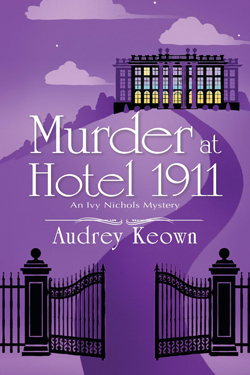
Murder at Hotel 1911 is the first book in the NEW “Ivy Nichols” traditional mystery series, released September 8, 2020.
A hotel clerk prone to panic attacks turns amateur detective in this elegant and atmospheric murder mystery.
If you want to spend a night amid the luxury and charm of the early 20th century, book a room at Hotel 1911. You’ll find 28-year-old Ivy Nichols behind the reception desk. The hotel is Ivy’s only link to the family that abandoned her when she was a small child. Now, plagued by panic attacks, she pedals her sea-green Schwinn bicycle to work every evening, hoping desperately to hold on to her job.
When wealthy, imperious Ms. Swain arrives at the hotel and belittles Ivy, the young woman seeks consolation in the welcoming kitchen of George, the hotel’s chef. Despite her tormentor’s barbs, she dutifully informs George that Ms. Swain has a deadly allergy to shellfish. So when Ms. Swain collapses at dinner and dies, the police suspect that the chef made a tragic, inexcusable error. Desperate to save George’s career, Ivy sets out sleuthing. She learns that numerous people in and around the hotel had motives to contaminate Ms. Swain’s plate. Among them are Jeffrey Swain, the victim’s son and heir; painter Rose Jewett; and British expat Hemal Sandeep.
Even after the police find traces of shellfish in George’s kitchen, Ivy is determined to clear her friend’s name. But the stress of the investigation, in a hotel filled with suspects, threatens to precipitate another terrifying panic attack. . .or something more deadly.
Meet the author
Audrey Keown set her debut mystery series in Chattanooga, Tennessee where she began her career as a journalist. She lost her heart to the city in the early days of its downtown revival, and its bridges, breweries, parks, and people are its mixtape back to her. Her fiction features themes of redemption and connection to the past. Like her protagonist, she has battled anxiety and hopes that writing about it will help lift the stigma. Murder at Hotel 1911 is out September 8, 2020 with Crooked Lane Books.
All comments are welcomed.
Sounds fascinating!!! I want to read this one.😊
Thanks, Barbara! 😁
I have this on hold at the library
Thanks for making your reservation for Hotel 1911, Sandy!
Good morning Dru, this one looks interesting. Enough so I added it to my want to read list on Goodread’s. Hopefully Queens will order it and I’ll be able to take it home to enjoy.
Thanks so much for the Goodreads add, noraadrienne! Hope you’ll enjoy it!
I have been reading your reviews as I am no longer writing reviews. I think I will download this book as it sounds good. Thanks for sharing and say hi to the cozy armchir group.
Thanks for your support, bettylouise31! Hope you enjoy your stay at Hotel 1911.
I love the premise of this book!
I love hearing that, Pat!
Sounds like a great new series. I’m sure that both my husband and I will like this story a lot.
Love starting a new series and with a new author as well. Best of everything and Congratulations, Audrey.
That’s so kind of you, Cynthia! Thank you, and I hope you enjoy your stay at Hotel 1911!