
 My name is Louise Pearlie. I believe we’ve already met, back when I first arrived in Washington, DC, in January of 1942. Two years have passed, two years that have changed me forever. I was an unemployed widow, dependent on my parents, when the war came. I found freedom, personal and financial, when I began my new job at the Office of Strategic Services. OSS was our country’s new spy agency. There I filed and retrieved documents and kept secrets. Soon I had a paycheck, my own room in a nice boardinghouse, good friends and a charge account at Woodies. I learned to like martinis. And I had a lover too, Joe Prager, a Czech refugee. Oh I’d read about women having lover affairs in romance novels, but I never expected to have one myself. I was the kind of woman who was supposed to get married. But the war, horrible as it was, changed that for me and many other women like me. The Depression ended. We could get jobs. Now we could take care of ourselves.
I’d been told by my first employer, back in Wilmington, North Carolina, that I knew how to keep my mouth shut. My bosses at OSS soon learned that I wasn’t just reticent, I was competent too. So I got some special assignments in addition to my regular duties. Jobs that involved spies, danger and murder.
For two years I lived an exciting life. Days and nights of work was interrupted by dinners at Harvey’s and the Sea Grill, listening to the Washington Symphony on the steps of the Watergate and ice-skating on the Reflecting Pool. I met Clark Cable at a party and heard Louis Armstrong sing and blow his horn at the Club Bali.
Of course the war has caused privations. We have little meat, sugar or coffee. Fuel rationing means winter is frigid and automobiles are left mounted on blocks in driveways. Here in Washington government workers crowd boarding-houses. Sometimes a dozen people will share one bathroom. And every day as I walk to work I pass by homes with a gold star, or more, hanging in a window. One gold star for every young person who has died many miles from home.
And now my life has changed again. Joe is gone. He left without saying goodbye to me. I do know he’s posted overseas, but that’s all. Joe works undercover for an organization assisting Jews to escape the Nazi-controlled areas of Europe. His work is secret and dangerous. I might never see him again. If he does survive the war I expect he’ll travel immediately to Czechoslovakia to find his family. I would if I were he.
I need to move on. Washington has become stifling for me, reminding me every day of my lover. I hope a change of scene and a new job will distract me from my loneliness and fear. Joe would expect me to pull myself together and get on with doing my part to end the war.
Which is why I’m standing at the foot of a tall metal staircase waiting to board the Liberty Ship Amelia Earhart, bound for Liverpool, England. I’m headed to London in the dead of winter, February 1944, where the privations I’ve experienced here will look like a summer picnic during peacetime. I’ll join the Morale Operations office at the OSS headquarters in London, planning for an invasion of Europe in the fall. I’ve packed my trunk with an Arctic parka, long underwear, an extra pair of glasses and jars of peanut butter. I’m carrying a fifth of Gordon’s gin in my musette bag. A motley group of other casual passengers are waiting here with me for a seaman to gesture us aboard. Tomorrow I’ll sail with a shipload of complete strangers across a frigid Atlantic Ocean on a four-week journey through gales, random icebergs and a flotilla of German submarines. What could go wrong?
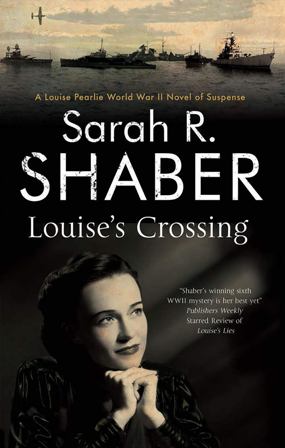
You can read more about Louise in Louise’s Crossing, the seventh book in the “Louise Pearlie” historical mystery series, released May 1, 2019.
Government girl Louise Pearlie is thrilled to be posted to London, but her journey across the Atlantic proves to be anything but plain sailing. . .
February, 1944. Washington D.C. With the war entering its most dangerous phase, Louise Pearlie is thrilled to be reassigned to the London office of the OSS. But in order to take up her new post, she must make a perilous crossing of the Atlantic Ocean in the SS Amelia Earhart.
Accompanying her on the voyage to Liverpool are an eclectic group of passengers, including the aloof Blanche Bryant, whose husband, Eddie, died in mysterious circumstances on the ship’s voyage out to New York three months before. Most of the same crew and passengers are on the return voyage, and one question remains: was it really suicide?
When the body of one of the passengers is found on deck, it’s clear that German bombs and raging storms aren’t the only threats to Louise’s safety. Can she expose a brutal killer before the ship docks in England?
Purchase Link
# # # # # # # # # # #
About the author
Shaber is an award-winning writer from Raleigh, North Carolina. She wisely earned degrees from both local rival universities, Duke University and the University of North Carolina at Chapel Hill.
Previous careers included advertising, publishing sales and marketing, and legislative lobbying. She threw over all that education and work experience to write SIMON SAID, her first mystery, which won the St. Martin’s Press/Malice Domestic Award for Best First Traditional Mystery, and which was followed by four sequels.
She’s also the editor of Tar Heel Dead, a collection of short stories by North Carolina mystery writers. Schaber’s most recent work has been the Louise Pearlie series, set during World War II in Washington DC.
To learn more about Sarah, visit her website at sarahshaberbooks.net.
All comments are welcomed.
This series sounds so interesting! I will definitely need to look into it. Thanks for having a Day in The Life of Louise Pearlie on your blog, Dru Ann ~