
 Less than sixty seconds after arriving home to my apartment, my next-door neighbor’s foster daughter knocked at my door. Bianca, a seventeen-year-old with a genius level IQ, was in her final semester of a computer science degree at George Washington University in DC. She seems to always know when I arrive at home, and I’m convinced she’s used her computer skills to set up some sort of monitoring system.
Bianca had come bearing a gift of food from Mrs. Gomez, her foster mother. Mrs. G seemed to be of the opinion that I was constantly in danger of starving to death, so she sent over delicious home-cooked Chilean delicacies to prevent my imminent demise.
I accepted the plate of empanadas and Bianca followed me into the kitchen, where she plopped down to share the meal. She came over to visit whenever the small horde of younger foster kids made Mrs. G’s apartment seem a bit too cramped, which amounted to about three or four times a week. We were at the table sharing food and gossip when my cell phone buzzed on the counter.
An hour later, I was at the Behavioral Analysis Unit in the Aquia Commerce Center near Quantico. One of my colleagues, Dr. Jeffrey Wade, explained that we had been asked to assist the Montgomery County Police with two apparently related homicides that had occurred one week apart in Bethesda, Maryland.
Seven days ago, the five top executives of a multi-million-dollar tech firm held a late-night meeting in an otherwise deserted secure facility. The CEO had been murdered shortly after the meeting ended, which left four suspects and no witnesses. Tonight, one of those four had just been murdered in his home, leaving three remaining suspects.
As I reviewed the statements police had obtained, my mind flashed back to Bianca. Last week, she had asked me to test out an online murder mystery game she and a few of her fellow computer science majors were developing.
“You should use game theory to solve the crime,” she said when I kept losing to the other players. “Gamers use mathematical models and predictive analysis to formulate a hypothesis about how individuals will strategically interact within a confined setting.”
This is how she talks. All. The. Time.
Today, I reflected on that computer game, figuring it was a high-tech version of a locked room mystery, only using gaming strategy, which sounded a lot like deductive reasoning to me.
According to Bianca, players often attempt to deflect suspicion by setting someone else up to find the body. In our current investigation, the person who found the CEO’s body last week had been murdered tonight. Until now, he had been the main suspect because he’d been the only one known to be alone with the victim.
My mind raced ahead, making the next logical leap as I scrolled through the digitized police reports on my computer. When interviewed by Homicide detectives last week, tonight’s victim claimed he’d discovered the CEO murdered after the chief financial officer requested special project funding. Why would the chief financial officer send someone else to ask about monetary issues?
A question I intended to put to the CFO, who suddenly had a lot of questions to answer.
I could never tell Bianca any of this, of course. I couldn’t disclose investigative information and, more to the point, she’d never let me hear the end of it if it turned out her computer game had given me a lead to follow up.
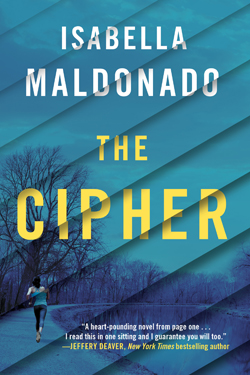
The Cipher is the first book in the NEW “Nina Guerrera” thriller series, released November 1, 2020.
To a cunning serial killer, she was the one that got away. Until now. . .
FBI Special Agent Nina Guerrera escaped a serial killer’s trap at sixteen. Years later, when she’s jumped in a Virginia park, a video of the attack goes viral. Legions of new fans are not the only ones impressed with her fighting skills. The man who abducted her eleven years ago is watching. Determined to reclaim his lost prize, he commits a grisly murder designed to pull her into the investigation. . .but his games are just beginning. And he’s using the internet to invite the public to play along.
His coded riddles may have made him a depraved social media superstar—an enigmatic cyber-ghost dubbed “the Cipher”—but to Nina he’s a monster who preys on the vulnerable. Partnered with the FBI’s preeminent mind hunter, Dr. Jeffrey Wade, who is haunted by his own past, Nina tracks the predator across the country. Clue by clue, victim by victim, Nina races to stop a deadly killer while the world watches.
About the author
Isabella Maldonado wore a gun and badge in real life before turning to crime writing. The first Latina to attain the rank of captain in her department, she retired as the Commander of Special Investigations and Forensics. During her career, her varied assignments included hostage negotiator, department spokesperson, and precinct commander. Selected to attend the prestigious FBI National Academy in Quantico, she uses her extensive law enforcement background to bring a realistic edge to her writing. Available now is The Cipher, the first book in her new series featuring FBI Special Agent Nina Guerrera. Visit her website at isabellamaldonado.com.
All comments are welcomed.
Thanks for featuring Nina Guerrera on your A Day in My Life blog. I look forward to reading The Cipher ~
So glad to hear from you, Celia! I’ve gotten a lot of positive response about the Bianca character, so I thought I would have some fun with her on this post!
Congratulations to the author for this exciting new series. Both my husband and I are truly looking forward to reading.
So excited to hear from you, Cynthia! I hope you and your husband will enjoy The Cipher. Please reach out to me at my email address: isabella@isabellamaldonado.com so I can confirm your information! 😉
I normally read cozies, but this book has piqued my interest. I am adding it toy list!
Thrilled to hear you are interested in The Cipher. It’s definitely the opposite of a cozy in every way, but many readers have responded really well to this edgy, gritty story because of the heart of the main character!