
 My mother never worked a day in her life and my younger sister’s “job” is to be the most beautiful debutante in all Manhattan, but it’s 1911 and I want to do something interesting and productive with my days. That’s why at 9 a.m. I head for the Moonrise Bookshop, the leading bohemian bookstore in New York, where I work as a salesgirl. Artists, poets, novelists, sculptors, I meet them all.
I don’t receive a salary. How can I do other than volunteer there when my grandfather, who bought shares in a Colorado copper mine before I was born, was one of the richest men in America? I just wish money brought happiness. It hasn’t been the case in the house on East 72nd Street where I grew up. My father was a hopeless womanizer who disappeared for weeks at a time. When I was fifteen years old, he died in a boating accident—his young mistress survived and sold her story to the newspapers.
That wasn’t the end of our painful disaster. It turned out my dissolute father died broke! My mother doesn’t want to depend on family charity, but I have a terrible feeling that her idea of a solution is for my gorgeous sister Lydia to hurry up and marry Henry Taul, the young man who will inherit a mining fortune of his own. I had a brief romance with Henry a few years ago. It ended badly when I saw Henry’s controlling nature turn darker. I’ve tried to warn Lydia, but she won’t listen.
Now my uncle is forcing me to leave Moonrise Bookshop, saying that I need to accompany my family to an oceanside hotel for a summer holiday. Why do I have the feeling Henry Taul is behind this maneuver? And how on earth do I say no?
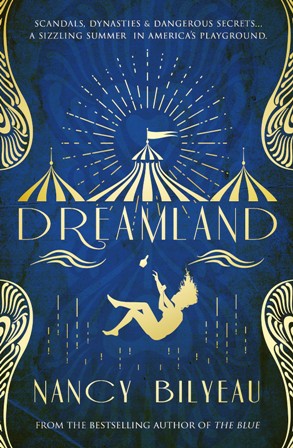
You can read about what happens to Peggy, who is loosely based on Peggy Guggenheim, in the historical mystery Dreamland, published January 16, 2020.
In the novel, heiress Peggy Batternberg reluctantly accompanies her family for a holiday at the luxurious Oriental Hotel on the Atlantic Ocean. Less than a mile away, Coney Island, “America’s Playground,” beckons with forbidden delight, and she meets an immigrant artist who fascinates her in the fantastical parkground called Dreamland. But there’s also danger for Peggy in Dreamland, and for those she loves most.
Library Journal and Publishers Weekly have given the novel starred reviews, and Good Housekeeping magazine featured Dreamland on its list “The 20 Best Books of 2020 So Far”: “Don’t sleep on this beautiful novel that twists and turns like the Cyclone through Coney Island. Socialite Peggy is sent to spend the summer there, and she’s not happy about it – that is, until she falls in love with one of the artists on the pier. When bodies start piling up in the summer heat, Peggy has to untangle a web of deceit before she or those she loves end up asleep forever.”
Author copies of “Dreamland” can be mail-ordered through Bookshop in Manhattan.
Purchase Link
# # # # # # # # # # #
About the author
If you tell Nancy Bilyeau that reading one of her historical novels of suspense is like strapping yourself into a time machine, you’ll make her a very happy woman. She loves crafting immersive historical stories, whether it’s the Gilded Age of New York in “Dreamland” and “The Ghost of Madison Avenue,” the 18th-century European porcelain workshops in “The Blue,” or Henry VIII’s tumultuous England in “The Crown,” “The Chalice,” and “The Tapestry.”
In “The Blue,” Nancy drew on her own heritage as a Huguenot. She is a direct descendant of Pierre Billiou, a French Huguenot who immigrated to what was then New Amsterdam (later New York City) in 1661. Nancy’s ancestor, Isaac, was born on the boat crossing the Atlantic, the St. Jean de Baptiste. Pierre’s stone house still stands and is the third oldest house in New York State.
To learn more about Nancy, visit her website at nancybilyeau.com.
What an interesting synopsis. This is going into my TBR pile. This book feels hypnotic. Thanks Dru!