
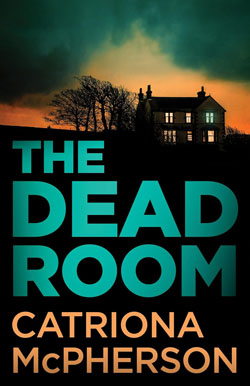
 I like writing about houses and the house in The Dead Room – St Helen’s – is an important character. When my protagonist Lindsay buys it and moves in she’s got high hopes for a fresh start. No spoilers, of course, but here’s the jacket which is a clue about how well it goes.
←
I like reading about houses just as much and some of my favourite novels have houses at their hearts, whether they’re creepy, cosy or . . . actually they’re all creepy in one way or another, at some point in the story, whether they start creepy and end up cosy or start seemingly cosy and go very bad along the way.
Another thing I like a lot is a Top Five.
So here, Gentle Musing Reader, is a top five of novels with great fictional houses.
5. A recent find was Rachel Harrison’s PLAY NICE. It’s in the horror genre so I knew what I was getting, but still that jacket image pulled me in. I’d buy this house.
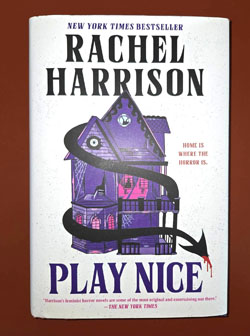
The twist inside the jacket was that the possessed house isn’t a ramshackle Victorian or a Gothic pile; it’s a split-level in a cul de sac, complete with beige shag-carpeting, fake wood-paneling and wrought-iron banisters. The sheer ugliness of the house adds no end to the darkness of the story. (I’ve never understood split-levels, but I’ve had a soft spot for them that I got reading Harlan Coben. Don’t Myron Bolitar’s parents live in one?)
4. THE RAILWAY CHILDREN, by E. Nesbitt. There’s something about the way the children and their mother arrive at their new house in the country that thrilled me when I was a kid and still does. I never moved house when I was wee (my mum still sleeps in the room where I was born) but these lucky children got to walk across dark fields from a railway station and let themselves into a completely strange house with a key they found under the doormat. And what a strange house it was! They think they’ve been left in the lurch by the woman who was supposed to lay in provisions for their arrival. It’s not until the next morning, in daylight, that they find a whole extra room they missed in the dark, complete with a ham and an apple pie on the table. The notion of finding an extra room in your house hit me like a thunderbolt.
3. BUSMAN’S HONEYMOON, by Dorothy L Sayers. Surely DLS had the railway children in mind when Peter and Harriet arrive on the night of their wedding day, at a house in the country where a local woman is supposed to have made it ready for them, only to find cold hearths and unlit lamps? I don’t know if Talboys, which Peter buys for Harriet, the place were they spend WWII in happiness despite everything, is based on a real place. DLS conjures it so completely I think it might be. Or maybe she imagined the perfect, easy, chintzy, sun-filled English house just as she dreamed up the perfect, witty, clever, loving English gentleman. What surprises me when I re-read is that she doesn’t actually describe every bit of Talboys in great detail. She sketches it and leaves it to the reader to complete. Which I have, until I could draw a floorplan.
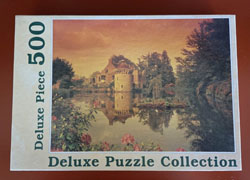
2. I did draw a floorplan the first time I read Dodie Smith’s I CAPTURE THE CASTLE. She does describe it fully, mind you, and there are some sketches in the section breaks too. So I’m confident that my mental picture of Godesend Castle – a Tudor house built onto the ruins of a Norman stronghold, surrounded by a moat – is accurate (although I can never work out where the kitchen staircase come out upstairs). Godesend in the book is in the grounds of an even bigger castle called Scoatney and nothing will ever stop me from believing that Smith was thinking about Scotney Castle in Kent when she made the setting for her story in Suffolk. I happen to have a jigsaw puzzle of Scotney Castle and I rest my case.
1. But my absolute favourite and therefore number one fictional house is the one that Gwenda Reed buys for herself and her husband Giles at the start of Agatha Christie’s SLEEPING MURDER. It’s perfectly balanced between creepy and cosy and it was in a spirit of sincere hommage that I made my heroine buy a house she wanted to love and couldn’t help being scared of. (My heart soared when JC Bernthal – renowned Christie scholar – said in the newsletter The Christie Catch-up that The Dead Room was a clever tribute to Sleeping Murder as well being satisfying in its own right.) I even have Lindsay reading Sleeping Murder during the events of the novel, finding out for herself that anyone who thinks Christie is cosy isn’t paying attention.
I’d love to hear about your favourite fictional houses – I’m sure I’ve missed loads that I love but I’m also looking forward to some new ones.
Giveaway: Catriona has generously offered to give away one print copy of THE DEAD ROOM. To enter, please leave a comment below. One entry per person and the giveaway is limited to U.S. residents only. Giveaway ends May 6, 2026. Good luck everyone!
THE DEAD ROOM
Genre: Psychological Thriller
Release: May 2026
Format: Print, Digital, Audio
Amazon | Barnes & Noble | Bookshop.org
In this atmospheric thriller from Catriona McPherson, a young widow seeking refuge from her grief wades into the mists at the far end of memory lane—where something even darker awaits.
Reeling from the death of her husband, thirty-something audiobook narrator Lindsay Hale retreats to her Scottish hometown and the comforts of old times. The bungalow where she grew up is just as she left it, next to the scrapyard her family still owns. But something is wrong…something beyond grief.
Something she can only glimpse from the corner of her eye.
Lindsay’s brother and best friend are there to welcome her back. An elderly widow helps Lindsay make sense of her new normal, and a kind man hints at unexpected possibilities. But when her widow friend vanishes, only Lindsay seems to notice. And while she starts “recognizing” strangers, she begins forgetting familiar faces.
Every night, as Lindsay’s dream house fills with nightmares, she wonders whether she’s truly unraveling—or if something more sinister’s at play. Buried secrets surface and reality bends, forcing Lindsay to face the terrifying truth that her new haven isn’t so safe after all.
 About the author
Catriona McPherson (she/her) was born in Scotland and immigrated to the US in 2010. A former linguistics professor, she is now a full-time fiction writer and has published: preposterous 1930s private-detective stories; realistic 1940s amateur-sleuth stories (The Edinburgh Murders is latest); and contemporary psychothriller standalones (The Dead Room is the brand-new one). These are all set in Scotland with a lot of Scottish weather. She also writes modern comic crime capers about a Scot-out-of-water in a “fictional” college town in Northern California sneezedavissneeze. Scot’s Eggs, No. 8 just won for best humorous novel at Left Coast Crime in San Francisco. Her other novels have won Agathas, Anthonys, Leftys and Macavitys and been finalists for an Edgar, a CWA Dagger and three Mary Higgins Clark awards.
Catriona is a proud lifetime member and former national president of Sisters in Crime. Connect with Catriona at www.catrionamcpherson.com.
I’ve read all those except “Play Nice” … but you don’t mention “The Fall of the House of Usher,” or “We have always Lived in the Castle.”
or The Haunting of Hill House.
I haven’t read any of those books you mentioned but will have to check them out. When I think of haunted houses, the first one that comes to mind is in The Shining, by Stephen King.