 People ask what I do, and I’ve learned to watch their faces when I answer, because “I notice things” is a sentence that makes a grown adult quietly check the room for the exits. But it’s the only trade I’ve ever been any good at, so let me walk you through an ordinary Tuesday. Here’s what I know that the hurried people don’t: nothing worth keeping ever vanishes all at once — it vanishes because a whole town agreed, politely and without malice, to stop looking at it. My entire job is to be the one fool who refuses to look away, which is exactly as inconvenient as it sounds — mostly, these days, for Graham.
I’m up before the coffee is, which is its own small tragedy. I sit on the step and watch the street wake up. The man two doors down waters a lawn that’s been dead since the Carter administration; I’ve decided not to tell him, because some hopes are load-bearing, and you don’t knock those out without a permit. Then Graham drives — the car is his, a road-tired thing called the Green Flash that needs an oil change about as badly as I need to mind my own business. He takes the wheel and a good eighteen inches of unsolicited opinion to my left, and we go wherever the day points. I keep a stack of Field Notes on my knee, filled with strangers I’ve written down so I’d never quite have to be written down myself.
This is the part nobody warns you about. Everybody drives past the good stuff — not out of meanness, but out of momentum. The fruit stand older than the interstate that skipped its town. The hand-lettered sign that reads WE STILL FIX THINGS. The whole town that used to matter and was quietly never told otherwise — they slide past the window at fifty-five and they’re gone. Then the bulldozer comes, everybody’s heartbroken for an afternoon, and by evening even the heartbreak’s been paved and striped for parking. So we pull over. That’s the whole job.
By evening I’m working the day out in ink. My father did a version of this too — he used to say noticing is a form of generosity, and he was right, but he died a sentence short. Because noticing is only the first half. The rest — the half that costs you something — is staying. Staying long enough that the place, or the person, gets remembered by somebody who was actually there. So here’s my one ask: this week, take the long way. Your GPS will object — but your GPS, I’ve found, is a poor judge of a life. And when something small and true slides past your window — pull over.
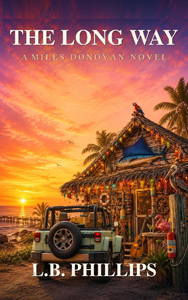
THE LONG WAY
Series: A Department of Small Wonders Novel, Book 1
Genre: Humorous Fiction
Release: September 2026
Format: Print, Digital
Purchase Link
Some places you’re supposed to drive past. Miles Donovan was raised to stop.
Miles is forty-six, spectacularly unpublished, and nursing a hangover in Key West when a stranger presses a postcard into his hand — one that’s been carried for fifteen years. A roadside pizzeria somewhere up the map. Three words on the back: DON’T DRIVE PAST THIS ONE. It’s signed with a single letter. B.
He should throw it away. Instead he points the car north.
What follows is the long way — a meandering, hand-drawn route through the parts of America that don’t make the brochure: fireworks stands and bait shops, a woman who keeps her late husband’s things in a back room, a town that would rather you kept driving. Miles is looking for the man who signed the card. What he finds is a knot of small, quiet wonders — and one secret somebody buried on a mountain road with no guardrail.
Warm, funny, and quietly devastating, The Long Way is a novel about noticing: the people we’re taught to drive past, and what it costs to finally stop.
Meet the author
L.B. Phillips is the author of The Long Way, Book One of the Department of Small Wonders series — a warm, funny Gulf-Coast road-trip mystery in the tradition of Tim Dorsey and Carl Hiaasen. It follows Miles Donovan, a man who takes the long way on purpose and notices the people and places the rest of us drive past. The Long Way is out September 1, 2026.